In this guide
The electrical panel is the least visible part of a kitchen renovation and the one that deserves the most respect. Cabinets can be adjusted, tiles can be replaced, and paint can be touched up. A panel that is overloaded, poorly bonded, or filled with the wrong breakers is a permanent risk hidden behind a closed door. A proper upgrade is not about adding more circuits for their own sake. It is about matching the service, the protection, and the documentation to the way the house actually uses electricity.
This guide covers the logic of a panel upgrade: how to estimate demand, how to choose protective devices, why earthing and bonding matter, and how to prepare for modern loads such as electric vehicle charging, heat pumps, solar, and batteries. It is not a wiring manual. Electrical work should be designed and installed by a licensed electrician, inspected under the local code, and never attempted live.
1. What the Panel Actually Does
The panel is the distribution point between the utility supply and the circuits in the building. It contains a main breaker or switch, busbars, and a set of protective devices for individual circuits. Its job is to divide the available current safely, isolate faults, and provide a means of switching off for maintenance.
Capacity is not only the number printed on the main breaker. The service conductors, meter, panel busbar, main breaker, and utility connection all have ratings, and the weakest link sets the limit. A “200 A panel” fed by a smaller service is not a 200 A supply. The electrician must verify the whole chain, including the condition of the existing cables and the utility's available fault current.
The Difference Between Rated Current and Real Demand
A 200 A label describes the service rating, not a guarantee that every connected load can run at once. Regulations apply diversity and demand factors because no house runs every appliance at full power simultaneously. The calculation estimates the maximum demand after those factors, then compares it with the service and panel rating. Good calculations show the assumptions clearly: floor area, cooking, water heating, heating and cooling, laundry, EV charging, and any known future load.
2. Load Calculation Without Guessing
Load calculation methods vary by country. In North America, the NEC provides a standard method with demand factors for dwellings; in many other regions, IEC-based rules or national codes apply. The principle is the same: list the connected loads, apply the permitted diversity, and check the result against the supply.
| Load | Typical consideration | Why it matters |
|---|---|---|
| Lighting and sockets | Floor area or connected load | Establishes the baseline demand |
| Cooking | Induction or oven, diversity applied | High short-term demand |
| Water heating | Storage or instantaneous | May dominate the peak |
| Heating and cooling | Heat pump, resistive backup, AC | Seasonal peak and starting current |
| EV charging | 7, 11, or 22 kW, managed or unmanaged | Can double the household demand |
| Solar and battery | Inverter output, export limit | Affects busbar and protection, not only supply |
An “all-electric” house needs a different calculation from a house with gas cooking and a gas boiler. A heat pump with resistive backup can create a winter peak that the summer air-conditioning load never shows. An unmanaged 22 kW car charger can exceed the entire service; a managed charger that communicates with the meter or panel can share capacity safely. Decide which strategy you are designing for before the equipment is ordered.
The Value of a Load Management Plan
Load management is not a workaround for a deficient service. It is a design choice that can avoid an expensive supply upgrade. Priority relays, current transformers, and charger controllers can pause the EV charger or the battery when the house approaches its limit. The plan must be documented, tested, and understandable to the occupant — not hidden in a contractor's app.
3. Protection: AFCI, GFCI/RCD, and SPD
Different faults need different protection. Overcurrent devices protect cables from overload and short circuits. Residual current devices (RCDs), known as GFCIs in North America, detect current leaking to earth and reduce the risk of electric shock. Arc-fault circuit interrupters (AFCIs) detect the signature of a dangerous series or parallel arc, often caused by damaged cables or loose connections. Surge protective devices (SPDs) divert transient overvoltages before they reach sensitive equipment.
The right mix depends on the circuit and the local code. Bathrooms, kitchens, outdoor sockets, and EV chargers commonly require RCD/GFCI protection. Bedrooms and living areas may require AFCI protection in some jurisdictions. A whole-house SPD at the panel is different from a point-of-use surge strip; the panel device protects the installation, while the strip protects a specific appliance.
Breakers Are Not Interchangeable
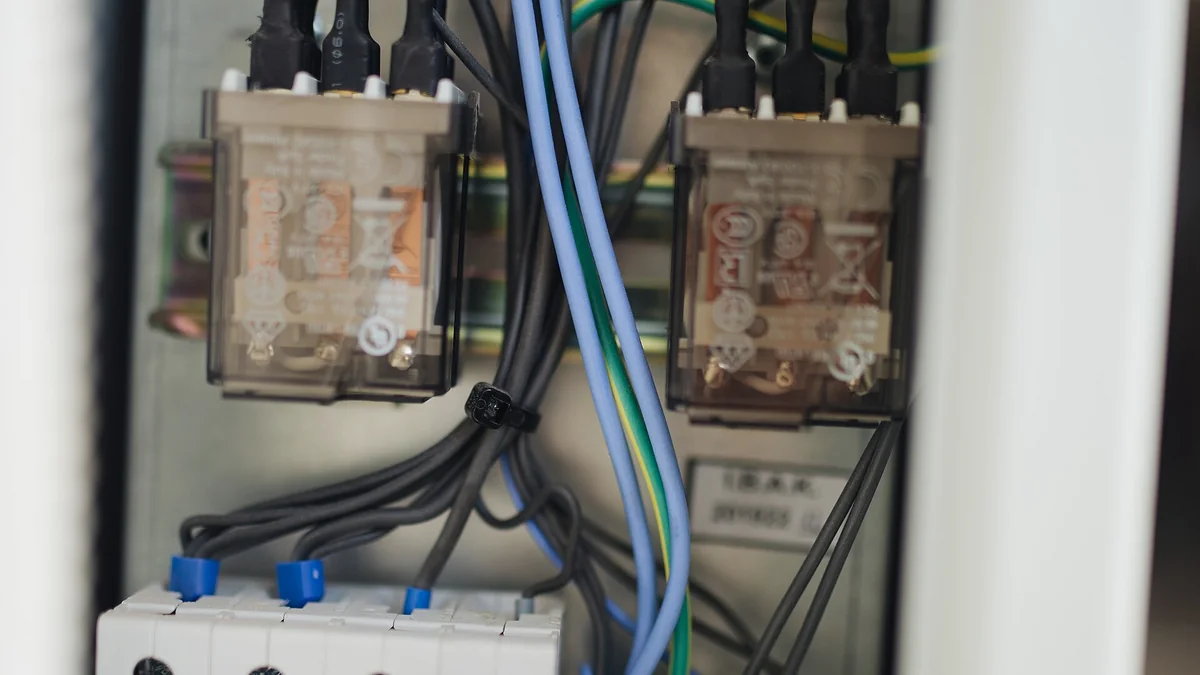
A breaker must be listed for the panel it is installed in. Mixing brands or forcing a breaker onto a busbar can create a poor connection, void the panel's rating, and fail under fault conditions. The same applies to “tandem” breakers: they are only permitted where the panel is listed for them and the busbar has the required capacity. A panel full of double-poles is not automatically a larger service.
4. Earthing, Bonding, and the Fault Path
Earthing gives fault current a low-impedance path back to the source so the protective device operates quickly. Bonding connects exposed metalwork — pipes, structural steel, equipment enclosures — so it stays at the same potential and cannot become a shock hazard. The two work together, and both depend on clean, tight, corrosion-resistant connections.
The earthing system type matters. A TN system uses the supply neutral or a combined earth; a TT system uses a local earth electrode and usually relies on RCD protection. Mixing the conventions without understanding the supply arrangement can create dangerous touch voltages. The electrician should test the earth electrode resistance, the polarity, the insulation resistance, and the trip times of every RCD before energising.
Bonding Is Not a Cure for Poor Wiring
Adding a bond to a metallic water pipe does not fix a missing earth elsewhere. It can even make a fault path worse if the pipe is not continuously metallic or if it is being used as an earth without permission. The design should follow the supply authority's rules and the local code, with test results recorded.
5. Modern Loads: EV, Heat Pumps, Solar, and Batteries
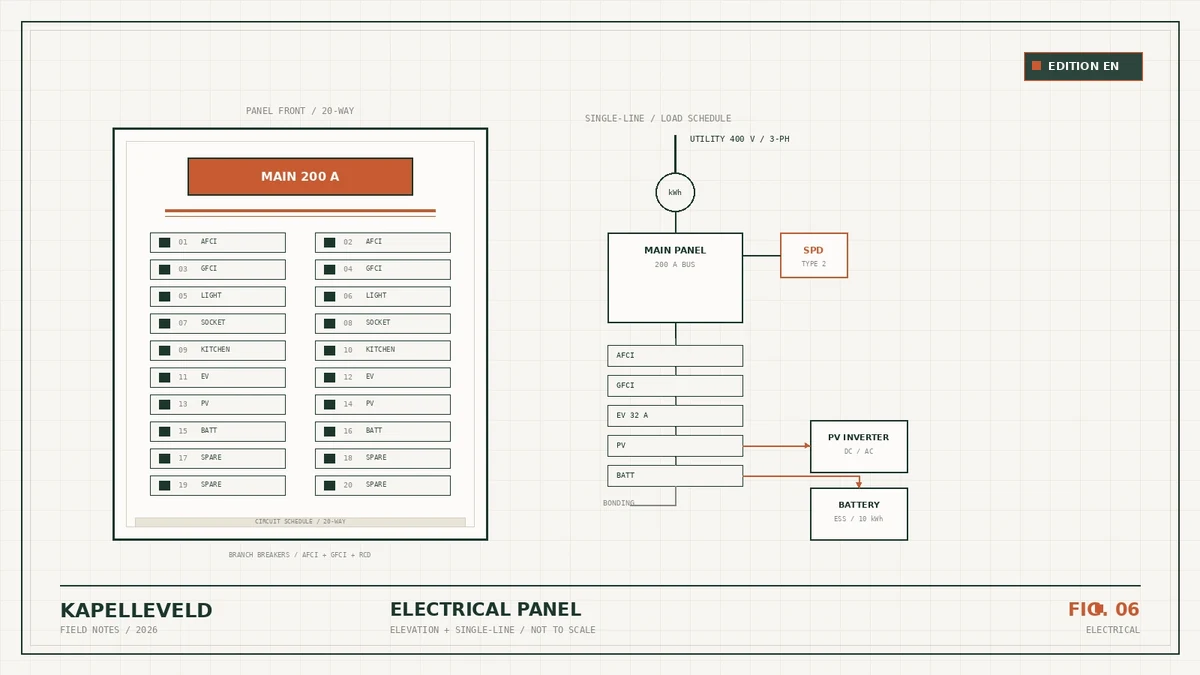
A panel upgrade is the moment to plan for electrification. An EV charger is a continuous load and may need a dedicated circuit, RCD protection, and energy management. A heat pump may need a three-phase supply or a soft starter to control starting current. Induction cooking can require a dedicated circuit with a high continuous rating. Solar and battery systems add generation and storage, which changes the fault current and the isolation strategy.
Solar inverters and batteries do not simply “reduce the bill”. They interact with the panel's busbar, the main breaker, and the utility's export limits. A generation system may require a line-side connection, a supply-side tap, or a dedicated generation panel. The inverter's output and the battery's charge/discharge profile must be included in the single-line diagram, and the labels must tell emergency responders what is still live.
Three-Phase or Single-Phase?
Three-phase power can distribute large loads more efficiently and is common in new homes in many countries. It also changes the protection and balancing requirements: single-phase loads must be spread across phases, and a lost phase can damage equipment. The decision belongs in the early design, not after the walls are closed.
6. The Upgrade Sequence and Inspection
A panel replacement is a planned outage, not an emergency. The electrician should survey the existing installation, label every circuit, identify shared neutrals and borrowed earths, and confirm that the meter and supply can be isolated. The utility may need to disconnect and reconnect; the local authority may need to inspect before and after.
- Survey and document: photograph the existing panel, record circuit names, cable sizes, and test results.
- Calculate and design: produce a load calculation, a circuit schedule, and a single-line diagram.
- Obtain approvals: permit, utility connection, and any landlord or building-management consent.
- Isolate and make safe: confirm dead, lock off, and protect the working area.
- Install: mount the enclosure, connect the supply, install breakers and SPD, and torque all terminations to the manufacturer's specification.
- Test and commission: continuity, insulation resistance, polarity, earth loop impedance, RCD trip times, and functional tests of every circuit.
- Label and hand over: a clear schedule, test certificate, and instructions for the occupant.
Torque matters more than most people expect. A loose terminal heats up under load, carbonises the insulation, and can start a fire. Good electricians use a calibrated torque screwdriver and record the values. They also keep the panel clean: no stray copper, no overcrowded bends, and no cables crossing the busbar.
7. Frequently Asked Questions
How do I know if my panel needs an upgrade?
Warning signs include frequent breaker trips, a panel that is warm to the touch, rust or burn marks, a fuse box with no RCD protection, insufficient spaces for new circuits, and a service that cannot support an EV charger or heat pump. A qualified electrician should assess the whole installation, not just the panel cover.
Can I add a circuit without replacing the panel?
Sometimes, if there is a spare way, the panel is listed for the breaker, and the load calculation still passes. The only safe answer comes after a survey and calculation. Adding a high-load circuit to a panel that is already at its limit is not an upgrade.
Is a larger panel always better?
No. A larger panel does not increase the supply capacity, and oversized equipment can be harder to protect selectively. The right size is the one that matches the calculated demand, the service, and a sensible allowance for future loads.
What should I do if I smell burning or see damage?
Treat it as an emergency. Do not touch the panel. If it is safe to do so, switch off the main supply from outside the panel, evacuate, and call the utility or a licensed electrician. Burn marks, melted plastic, and a hot cover are signs of a fault that needs immediate attention.
Conclusion
A panel upgrade is a small room with a large responsibility. The calculation decides the capacity, the protective devices decide the response to faults, the earthing decides the fault path, and the documentation decides whether the next electrician can work safely. Plan for the loads you have, leave room for the ones you can foresee, and insist on testing and certificates. The best panel is the one nobody notices — because it has been doing its job quietly for decades.
Read this guide in five editions
Electrical Panel Upgrades: Load Calculations, Circuit Design, and a Safer House
The same field notes, translated and adapted for each market.

Warm Minimalism & Earthy Kitchen Renovation Trends: How to Create a Timeless Home in 2026

Smart Multifunctional Furniture for Small Spaces: The Complete 2026 Urban Living Guide

Biophilic & Sustainable Modular Furniture Trends Transforming Modern Homes in 2026
Commercial HVAC Design, Controls & Maintenance: A Field Guide to Efficient Buildings